Generative Engine Optimization in 2026: A Practical Guide for Your Business


KEY TAKEAWAYS
Generative Engine Optimization in three minutes:
- Traditional search volume is forecast to drop 25% by end of 2026 (Gartner). AI Overviews already show on roughly half of Google queries. Discovery is moving from ranking to being cited.
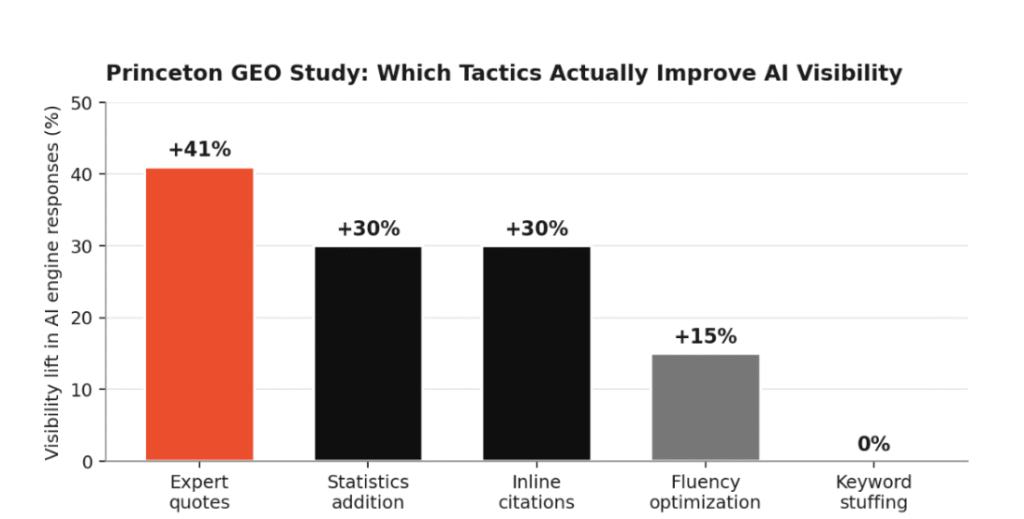
- The Princeton/Georgia Tech GEO study tested nine common content tactics. Three won. Expert quotes lifted AI visibility by ~41%, statistics by ~30%, citations by ~30%. Keyword stuffing did nothing measurable.
- AI-referred visitors (Perplexity, ChatGPT, Copilot) convert at roughly 4.4x the rate of organic search traffic. Perplexity-referred shoppers can convert up to 11x.
- The fastest GEO wins for an online business: answer-first paragraphs of 40-60 words, FAQPage and Article schema, citable statistics with sources, named-expert quotes.
A weird thing has happened in the last 18 months. A growing chunk of your future customers no longer scrolls through search results. They ask one question inside ChatGPT or Perplexity, read the answer, and click whichever brand the AI decided to name.
The data backs this up, even if your analytics dashboard hasn’t caught up. Google’s AI Overviews show on roughly half of US queries (Search Engine Journal, 2026). Zero-click searches sit at 65-70% of all Google traffic. And the moment an AI Overview appears, average organic CTR collapses from 1.76% to 0.61% (Position.digital, 2026). If your brand isn’t in the AI’s answer, you’re not in the conversation.
That is what GEO solves. Generative Engine Optimization is the work of structuring content so AI engines pick it as the answer they cite. This guide is what we actually use when we audit and rebuild client sites for AI search visibility. Plus the numbers we use to talk founders out of throwing their entire SEO budget at it on day one.
What Is Generative Engine Optimization (GEO)?
GEO is the practice of writing and structuring content so AI engines cite your brand when they answer a question. The engines that matter in 2026 are ChatGPT, Perplexity, Google AI Overviews, Microsoft Copilot, Claude and Gemini. The term comes from a 2024 paper by Princeton, Georgia Tech, the Allen Institute and IIT Delhi (GEO: Generative Engine Optimization), which measured exactly which on-page tactics actually move AI citation rates. It is the closest thing the field has to peer-reviewed evidence so far.
Where SEO competes for a position in a list, GEO competes for a sentence inside the answer. An AI engine reads dozens of pages, pulls the cleanest factual passages, and stitches them into a single response. The win is being one of those passages, with your brand attached to it.
You will also see this called Answer Engine Optimization (AEO). In practice, the two are basically the same in 2026. AEO leans toward question-and-answer formatting; GEO leans toward broader content engineering. Most playbooks combine both.
How Big Is the Shift? GEO in Numbers (2026)
AI search is no longer an emerging channel. It is a parallel discovery layer that already touches most of your buying audience, even if your analytics dashboard hasn’t caught up. Three numbers worth knowing in 2026:
- Traditional search volume will fall 25% by year-end 2026, with virtual agents taking most of the displaced queries (Gartner, 2024 forecast).
- Google AI Overviews reach about 2 billion monthly users across 200+ countries, while ChatGPT processes more than 3 billion messages a day from 700M weekly users (Semrush AI Search Trends, 2026).
- Conductor’s 2026 AEO/GEO Benchmarks Report measured AI referral traffic at 1.08% of total web traffic across 10 industries. Small in volume. But the visitors are high-intent: LLM-referred users convert at roughly 4.4x organic search rates (Superlines, 2026).
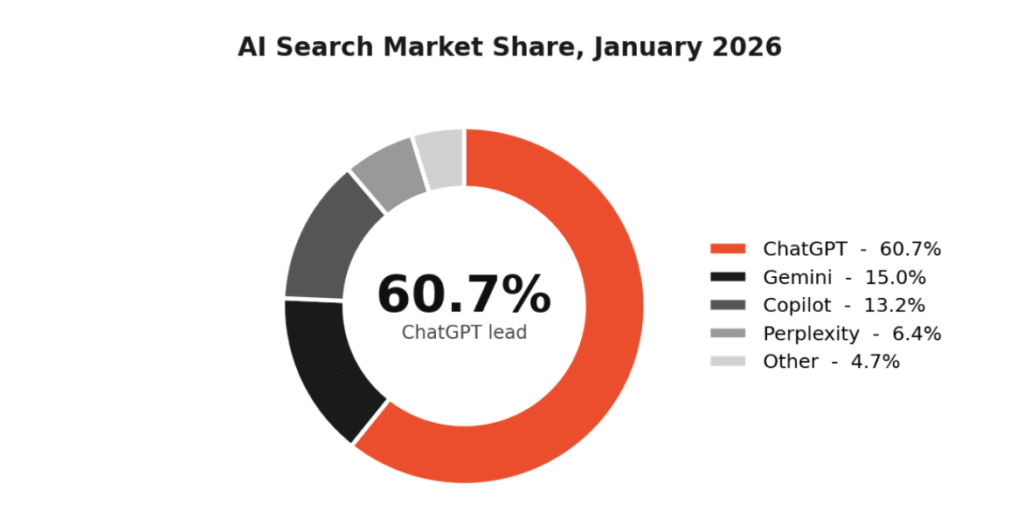
Market share between AI engines is consolidating fast. ChatGPT held about 60.7% of AI search market share in January 2026, with Gemini at 15%, Copilot at 13.2% and Perplexity around 6.4% (Stackmatix). For an online business, that distribution matters more than it looks at first. If your content isn’t citation-ready inside ChatGPT specifically, you are missing the bulk of AI-native demand right now.
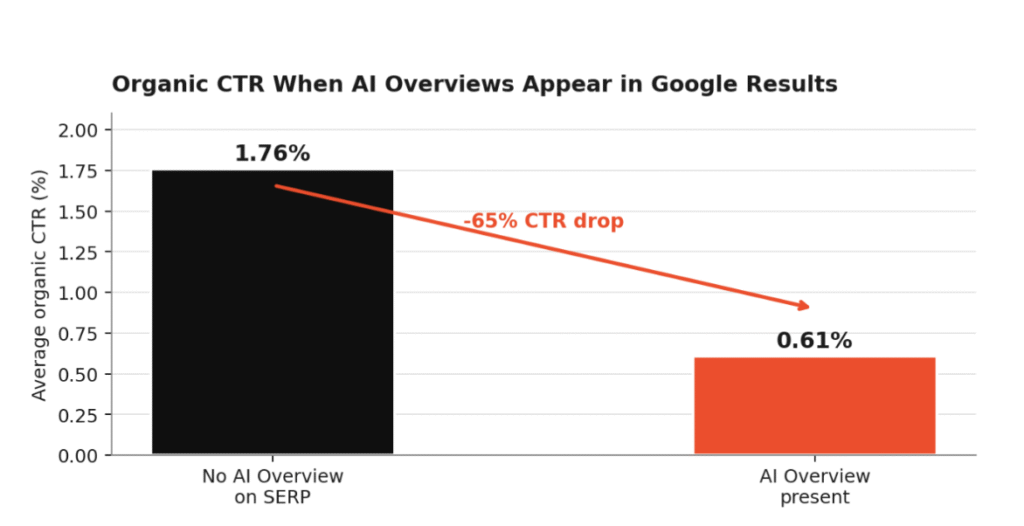
The CTR collapse on AI Overview SERPs is the single most-cited number in 2026 SEO conversations and the most misunderstood. Pages cited within the AI Overview itself earn 35% more organic clicks than uncited competitors on the same SERP (Search Engine Land). The penalty applies to sites that lose the citation, not to SERPs that include AI Overviews. That distinction is the entire game.
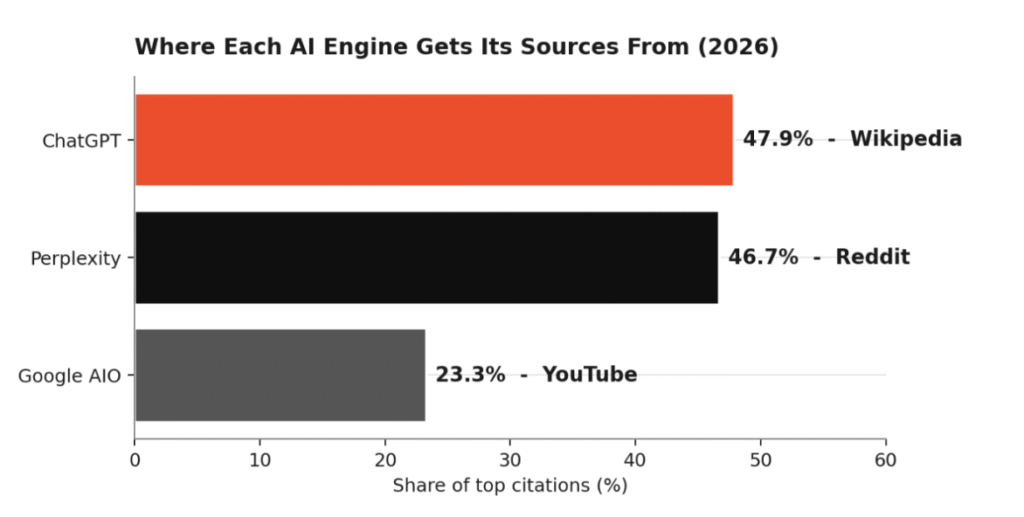
Each AI engine pulls from a different mix of sources. ChatGPT leans on Wikipedia and encyclopedic content (about 47.9% of top citations). Perplexity heavily prefers Reddit (46.7%). Google AI Overviews favor YouTube and other multi-modal sources (23.3%) (Leapd, 2026). For an online business, that means the citation strategy is multi-surface. Your blog needs E-E-A-T signals, your founders need a Reddit and forum presence, and your category pages probably need short YouTube companion videos.
Why GEO Matters Specifically for Online Businesses
For a content publisher, GEO mostly affects ad inventory. For an online business, it touches every revenue line. Branded discovery, organic traffic, paid acquisition cost, conversion rate, customer LTV. All of them. Three reasons we keep telling clients GEO is more urgent than it looks:
1. AI traffic is small in volume but premium in intent
AI assistants pre-qualify users before they ever land on your site. By the time someone clicks a citation inside ChatGPT or Perplexity, they have already accepted the AI’s framing of the problem and your brand as a credible answer to it. That shows up in the data. AI referral traffic converts at 14.2% versus 2.8% for traditional organic across e-commerce sites tracked in 2026 (Position.digital). Perplexity-referred sessions can convert at 11x the rate of standard organic on the same site.
2. Citation rates are uneven, so pick your platform priorities
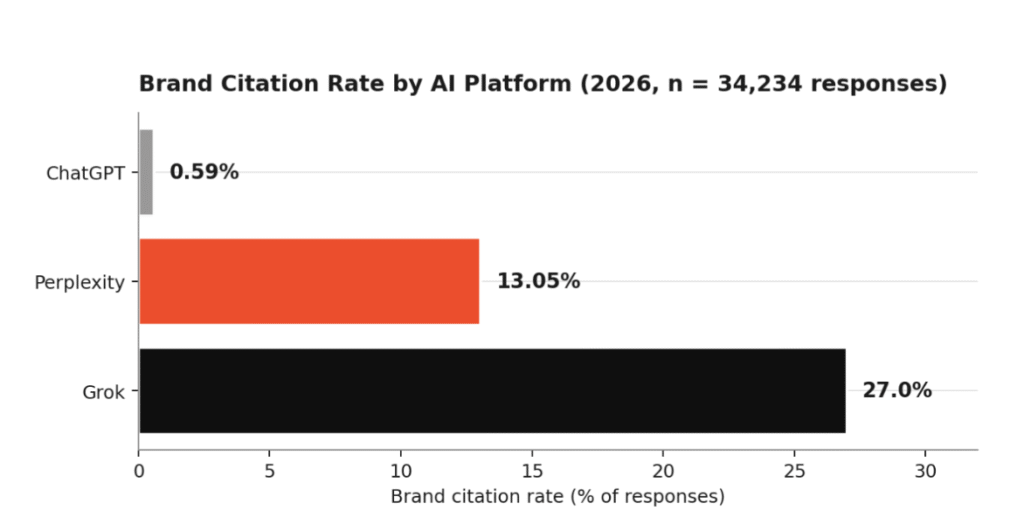
Averi’s analysis of 34,234 AI responses found a 46x gap in brand citation rates across platforms. ChatGPT cites brands in 0.59% of responses. Perplexity in 13.05%. Grok in 27% (Averi B2B SaaS Citation Benchmarks 2026). For online businesses that means two things in practice. Don’t spread GEO investment evenly across engines. And winning Perplexity citations is the highest-ROI early target, because Perplexity cites the most aggressively and converts the highest. That is not a small detail.
3. The competitive window is narrow
AI engines learn fast which domains they trust. Once an LLM has settled on a default set of trusted sources for a category, displacing them gets exponentially harder. Every time a competitor gets cited on a query, that citation feeds the engine’s evidence for citing them again. The brands that build citation-ready content in 2026 are setting the defaults the engines will keep using through 2027 and probably 2028.

GEO vs. SEO: 5 Key Differences (Side-by-Side)
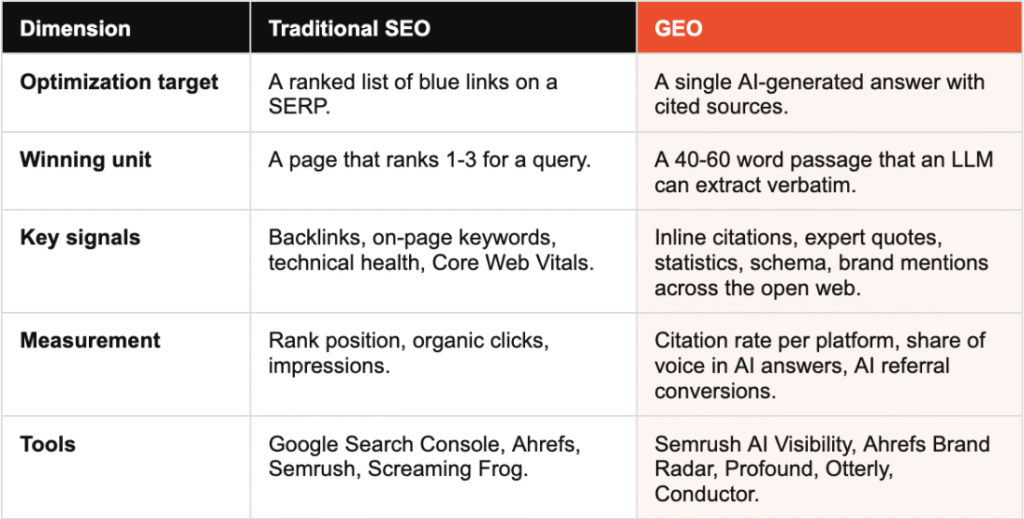
GEO is not a replacement for SEO. It is a layer on top. AI engines still draw heavily from top-ranking organic pages. In mid-2025, 76% of AI Overview citations came from the top 10 organic results, but by early 2026 that dropped to 38% in Ahrefs data and 17% in BrightEdge research. AI engines are starting to pull from deeper-ranking pages when those pages answer the question better. The takeaway: you can’t have a healthy GEO strategy on top of broken SEO. The two work together. Here is the practical breakdown of where they differ:
How to Optimize for GEO: A 7-Step Practical Framework
After auditing dozens of e-commerce, SaaS and local-service sites in 2025-2026, the same seven moves keep showing up across every site that gets cited well. Work them in order. Each step compounds the next.
Step 1. Lead every section with a 40-60 word direct answer
AI engines read the first one or two sentences after a heading and decide right there whether your page answers the question. If you open with a hedge, a summary of what is coming, or a definition you’ll get to later, the engine has already moved on.
The fix is mechanical. Every H2 and most H3s should open with a self-contained 40-60 word answer with one specific number and a source. The Princeton study calls this answer-first formatting. It correlates with citation more reliably than length, link count, or keyword density.
A worked example, on a product or category page.
Bad opener: “Sustainable running shoes are an increasingly important category…”.
Good opener: “The lightest sustainable running shoes weigh 215-240g (UK 9, 2026 average), with Allbirds Tree Dasher 3 and On Cloudsurfer Eco leading on durability tests over 500 miles.” That is the paragraph an LLM lifts.
Step 2. Add citable statistics, quotes and inline sources
The 2024 Princeton GEO study tested nine common content tactics. Three of them won decisively. Adding expert quotes lifted AI visibility by 41%. Adding statistics, 30%. Adding inline citations, 30%. Keyword stuffing, the legacy SEO crutch, did nothing measurable (Aggarwal et al., 2024). Practical rule for online businesses: every 300-400 words should contain at least one inline statistic with a named source and at least one named-expert quote.
Step 3. Implement layered schema markup (Article + FAQPage + BreadcrumbList)
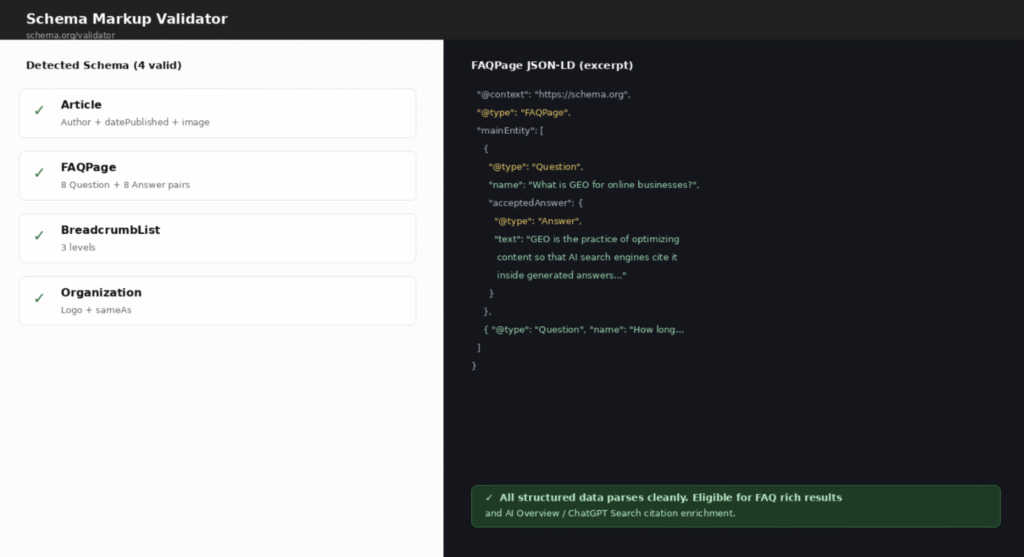
Pages with three to four complementary schema types get cited about 2x more often than pages with only one (SemRush, 2026 AI Overviews study). FAQPage schema specifically lifts AI Overview citation probability by 20-44% versus equivalent pages without it. Implementation priority for an ecommerce site: Article schema on every blog post and buying guide. FAQPage schema on every PDP, category and FAQ landing page. BreadcrumbList sitewide. Product + AggregateRating on PDPs.
Step 4. Optimize for question-based queries (and write the questions yourself)
AI engines rephrase user input into question form before they retrieve sources. Pages whose H2s and H3s already use the same question phrasing have a measurable extraction advantage.
Build the question library. Pull queries from Google Search Console (anything starting with what, how, why, which, vs), from People Also Ask, from Reddit threads in your category, and from internal sales-call transcripts. Use those exact phrasings as your section headings. Do not paraphrase them into something more “elegant.” The phrasing is the signal.
Step 5. Strengthen E-E-A-T signals across content and entity
AI engines treat unattributed content with suspicion. Three E-E-A-T moves have measurable citation impact in 2026: real author bios with credential links and sameAs profiles (LinkedIn, X, personal site); first-party experience signals (“in our 2026 audit of 47 sites, we found…”); and consistent entity disambiguation, which means the same brand name, founder names and locations across your site, Wikipedia where eligible, Crunchbase, LinkedIn Company Page and Google Business Profile.
Step 6. Diversify your citation surfaces (Reddit, YouTube, Wikipedia, niche forums)
Because Perplexity heavily cites Reddit and Google AI Overviews favour YouTube, your owned blog isn’t the only surface for GEO anymore. It is not even the highest-ROI one.
A balanced citation surface in 2026 looks like this. Active subreddit presence (founder or expert account, not the brand account). Short YouTube companion videos (60-180 seconds, embed back to the relevant landing page, ship with VideoObject schema). Third-party listicles and review platforms (G2, Capterra, Trustpilot for SaaS; niche aggregators for ecommerce). Wikipedia presence when you meet notability criteria. Most clients we work with cover one of these surfaces well and ignore the rest. That is the gap.
Step 7. Measure citations and iterate weekly
GEO without measurement is guessing. The minimum stack in 2026: Semrush AI Visibility (tracks 5 surfaces with daily prompt monitoring), Ahrefs Brand Radar, plus one specialist tool (Profound, Otterly or Conductor’s AEO Benchmarks). Track three numbers weekly. Citation rate per priority query. Share of voice versus your top three competitors. AI referral traffic with conversion rate. Anything you change in steps 1-6 should move at least one of the three within 30-60 days. If nothing moves, you are optimizing the wrong thing.
5 Common GEO Mistakes Online Businesses Make
From audits across e-commerce and SaaS sites in 2025-2026, five mistakes show up over and over. Each is fixable inside one sprint.
- Treating GEO as “SEO with extra steps.” GEO needs different formatting. The pages that win are not necessarily your highest-traffic pages. They are the ones with answer-first paragraphs and citable signals. Audit each page against the citation passage standard, not the ranking standard.
- Hiding the answer below “intro fluff.” Burying the direct answer below 200 words of context, brand backstory or definition is the single most common reason an LLM extracts a competitor’s passage instead of yours. We see this on roughly two-thirds of audits.
- Using fabricated or unsourced statistics. AI engines increasingly cross-check claims against linked sources. A statistic without an inline link to a credible source is treated as low-confidence content and skipped. Even when the number is correct.
- Skipping FAQPage schema on commercial pages. Most ecommerce teams add FAQPage schema only to dedicated FAQ pages. Adding it to category and PDP pages is one of the highest-leverage one-day fixes available.
- Blocking AI crawlers in robots.txt without realizing it. GPTBot, PerplexityBot, ClaudeBot and Google-Extended each respect robots.txt directives. A single “Disallow: /” left from an old privacy concern can erase your GEO surface entirely. Audit your robots.txt before anything else.
How to Get Started With GEO This Week (Quick-Start Action Plan)
If you can only invest 4-6 hours of focused work this week, do these three blocks in this order. They map to the highest-leverage parts of the framework above and will move at least one citation metric within 30 days. We have watched this exact sequence work on enough client kickoffs to recommend it without footnotes.
Day 1 (90 minutes): Baseline audit
- Run your top 10 buyer-intent queries inside ChatGPT, Perplexity and Google AI Overviews. Record which brands are cited and where you appear, or do not.
- Open validator.schema.org and check three of your highest-traffic pages. Note any missing FAQPage, Article or Product schema.
- Confirm your robots.txt does not block GPTBot, PerplexityBot, ClaudeBot or Google-Extended.
Day 2-3 (3 hours): Fix the top 5 commercial pages
- Rewrite the first paragraph after each H2 as a 40-60 word, statistic-rich, source-linked answer.
- Add a FAQ section (5-7 questions) at the bottom of each page, with FAQPage schema.
- Insert at least one named-expert quote on each commercial landing page.
Day 4-5 (90 minutes): Set up tracking
- One of the tools: Semrush AI Visibility checker against your brand name and top 5 commercial queries.
- Add a saved view in GA4 for AI referral traffic (sources: chatgpt.com, perplexity.ai, copilot.microsoft.com, gemini.google.com).
- Calendar a 30-minute review for two weeks out. Measure delta versus baseline. Double down on what moved.
The Bottom Line
GEO in 2026 looks a lot like SEO in 2010. A discipline that seems optional until your largest competitor adopts it, at which point catching up takes 12-18 months instead of one weekend. The mechanics are knowable. The tooling exists. The cost of acting now is a few sprints of content and schema work. The cost of waiting is paying paid-acquisition rates to re-acquire customers that your AI-cited competitors are getting for free.
If this guide helped, the next move is operational. Take 90 minutes today to run the baseline audit in the Quick-Start section.
Start with GEO Services from Elit-Web: Let’s Optimize for the Future
AI search optimization is no longer just a trend, it’s becoming a new reality for businesses across every industry. But this shift shouldn’t be seen as a threat. It’s a new opportunity to generate visibility, traffic, and sales through platforms like AI-powered search engines and generative assistants.
Brands that adapt early are already gaining an advantage in how customers discover products, compare companies, and make buying decisions.
Ready to future-proof your growth? Start with a free GEO audit from Elit-Web and discover: technical issues limiting your brand’s visibility in AI search, how AI platforms currently perceive your business and competitor benchmarks and visibility gaps.



Margaret Nest