Margaret is the Head of Marketing at Elit-Web and a marketing strategist with 5+ years of experience in B2B and B2C digital marketing
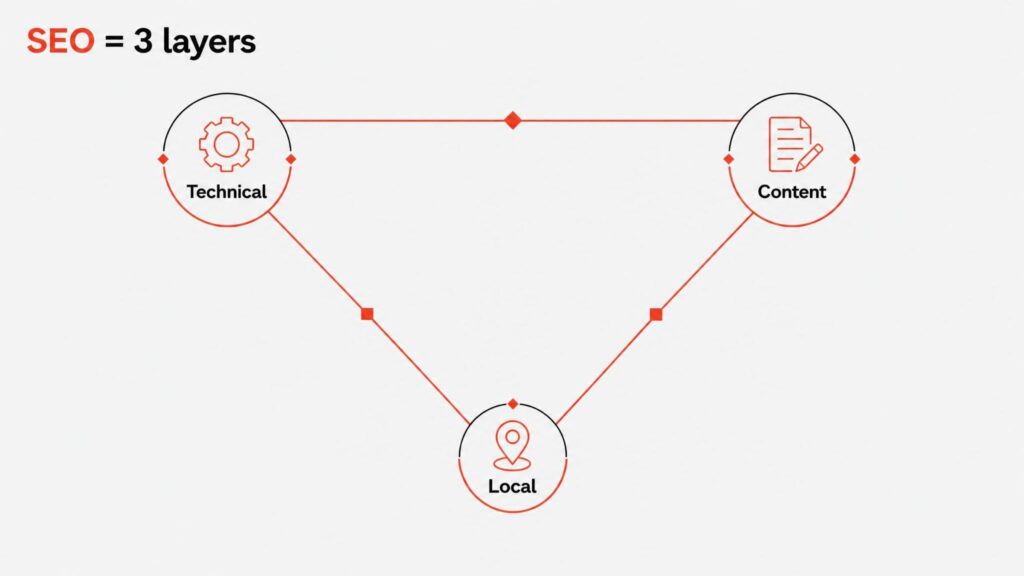
The online jewelry market is growing fast. But so is the number of stores competing for customers. A beautiful website and quality products aren’t enough if search engines can’t find and rank them. Jewelry SEO integrates technical fixes, content, and local visibility into a single system. The SEO guide shows how the approach varies depending on the business, whether it’s an independent shop, a scaling e-commerce brand, or a local storefront.
What is Jewelry SEO?
Jewelry SEO is the practice of optimizing a jeweler’s website and online listings. The aim is to make it rank higher in search results for terms the audience uses, like engagement rings, custom pieces, specific gemstones, or a jewelry store in their city.
Most customers conduct research before a high-value decision. SEO for a jewelry store also leans on trust signals. It includes reviews, transparent sourcing information, and detailed product content.
Local optimization matters just as much, since 46% of all Google searches carry local intent, and those searches convert at 28%. When done well, SEO for this niche connects all of this into a single system instead of treating each piece separately. So, technical fixes, content, and local visibility reinforce each other rather than working in isolation.
Expert Insights
Margaret Nesterenko
Head of Marketing at Elit-Web
Jewelry e-commerce is booming toward $85.7 billion, but converting under 2% of visitors means standard product pages aren’t cutting it. Since buyers research for months and visit multiple jewelers, the brands that win combine localized visibility with deep gemstone education and technical precision. Organic search isn’t just a traffic channel here; it’s the primary driver of credibility for high-value sales.
Why Your Jewelry Business Needs an SEO Strategy
The online jewelry market is projected to hit $85.7 billion in 2026, growing at roughly 13% a year. That growth attracts more competitors every year, while the average project in this niche still converts fewer than 2% of its visitors. An SEO strategy is one of the ways to capture a share of that growth, instead of watching it go to competitors who show up first in search.
Standing Out in a Competitive Jewelry Market
McKinsey identifies jewelry as the fastest-growing category in fashion by unit sales, expanding at four times the rate of clothing. That growth constantly pulls in new competitors, from DTC brands to marketplace sellers, crowding the same search terms.
A generic website isn’t enough anymore. SEO means standing out with content, trust signals, and local presence. Done well, jewelry SEO positions your store specifically rather than competing head-on with national chains on the same broad terms everyone else chases.
Driving Local & Organic Traffic to Your Store
Without organic and local visibility, a jewelry store has fewer ways to reach people who are actively searching. SEO changes that. It puts the store in front of people actively searching, both nearby shoppers ready to visit and buyers still comparing options online.
These two channels, local and organic traffic, work at once, neither of which requires an ongoing ad budget to keep functioning. For a business competing against national chains and marketplaces, SEO for a jewelry business is often the most popular way to get found by someone who’s never heard of the brand before.
Building Long-Term Search Visibility
Paid campaigns stop working the moment the budget runs out. Rankings in the search results, built through solid on-page SEO and consistent content, keep working long after that. SEO isn’t the only channel that compounds — an email list or loyal social following works the same way. What sets it apart is where the traffic comes from. Someone actively searching, not someone who already knew the brand. Though holding that position in a competitive niche like jewelry still takes ongoing work.
Key Elements of an Effective Jewelry SEO Strategy
A working strategy rests on several connected pieces. This includes finding the right keywords, structuring pages around them, earning authority through backlinks, fixing technical issues, and showing up in local search. Skip one, and the rest do less work than they should.
Keyword Research for Jewelry Business
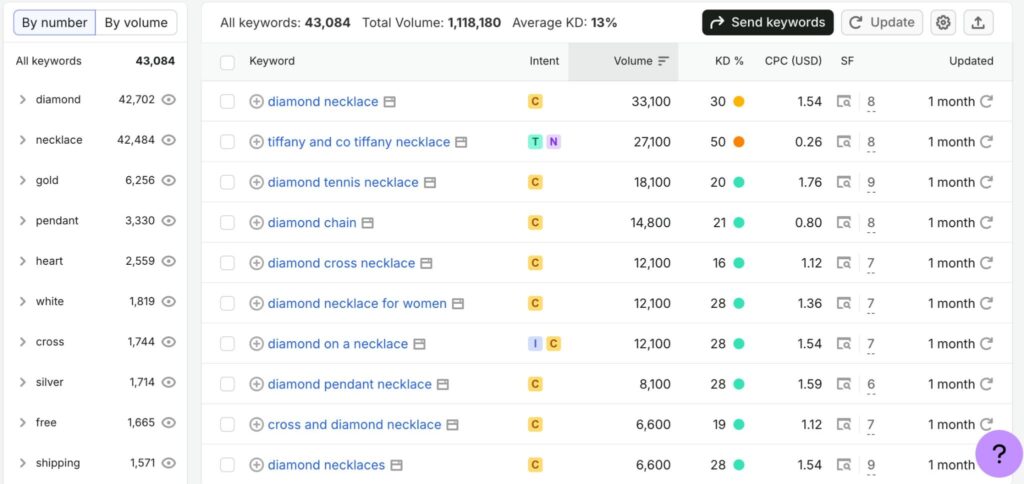
Real keyword research goes beyond “gold ring” or “diamond necklace”. Buyers search by metal, gemstone, cut, and occasion together. For example, phrases like “custom engagement rings” can convert better than broad terms. SEO for jewelers works by mapping long-tail phrases to specific pages rather than stuffing them into a single category.
That mapping also has to weigh search volume against real competitiveness. Chasing broad terms means competing with national retailers that have stronger domain authority and established SEO profiles.
On-Page SEO for Jewelry Websites
Product names matter for branding. But they rarely help rankings on their own. A brand can name a piece the “Cleopatra Necklace” and face zero search volume. The fix is simple — keep that name as the H1 and add an H2, such as “Diamond & Emerald Statement Necklace,” to capture the terms buyers use. Alt text like “18K gold solitaire diamond ring” describes the piece accurately, primarily for accessibility. That same specificity also helps search engines match the image to relevant product searches. Strong SEO for jewelry websites treats every product page as two audiences at once.
Off-Page SEO & Link Building
Backlinks carry more weight when they come from sites with real credibility in this specific niche. Gemology institutes, fashion magazines, and wedding-industry blogs all pass authority that a random directory link never will. Off-page SEO here works best built around real relationships (guest posts, influencer collaborations, PR tied to launches or events). That approach builds authority that holds up over time. Bulk-purchased links from low-quality directories work the opposite way. They tend to lose value fast and can hurt your rankings instead of helping them.
Technical SEO & Site Audits
A technical audit checks the fundamentals that decide whether Google can crawl and rank a site at all. It tests mobile responsiveness, HTTPS security, site speed, and crawlability. Product schema markup adds another layer on top. It helps search engines understand product data like price and availability, making the page eligible for rich results.
Running a full audit regularly catches issues before they drag rankings down. In particular, a broken redirect or a slow-loading page can undo months of other SEO work. Technical SEO here isn’t a one-time fix. It needs revisiting as the site grows and changes.
Local SEO for Jewelry Stores
Local SEO for a jewelry store starts with the basics, like identical business information across every listing. A fully optimized Google Business Profile builds on that foundation, backed by consistent reviews and location-specific content. The aim is to provide answers that shoppers are searching for. Together, these elements decide whether a nearby shopper finds the store or scrolls past it to a competitor with a cleaner local presence.
How to Implement SEO for Your Jewelry Store
Turning strategy into results comes down to three phases. Know where you stand, fix what’s broken, and build content that keeps earning visibility. Here’s how a working SEO strategy moves through each step.
Conducting an SEO Audit
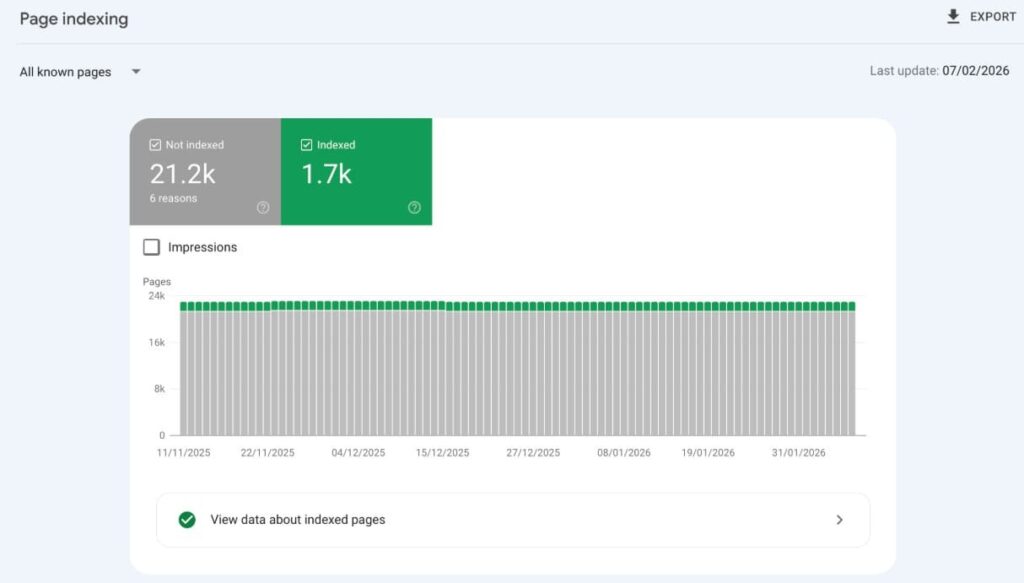
Start by conducting an SEO audit and checking whether Google can find and index your pages. Pull the Page indexing in Google Search Console to see which pages are indexed and which are excluded.
Larger jewelry sites often lose crawl budget to expired product listings and near-duplicate variant pages (the same ring in five metal options, each with its own URL). For a small or mid-size store, this usually isn’t a major factor. This step catches issues a surface-level look would miss.
From there, move to technical health checks. Look at page speed, since most jewelry shoppers browse on mobile. Check Core Web Vitals scores, HTTPS, and whether product schema is implemented correctly.
Tools like Google Search Console and Screaming Frog surface most of this automatically. This baseline makes jewelry SEO work measurable going forward.
Optimizing Product & Category Pages
Once the audit’s done, move to pages that actually convert visitors to buyers. For instance, every product page needs a unique title, a meta description, and alt text describing the piece specifically, not a generic template. Unique content helps each page match specific searches better on the search engine, instead of blending into a sea of near-identical listings.
Category pages need their own optimization, too. Terms like “engagement rings” and “wedding rings” carry different intent behind the search. Each category should target its own set of terms. Effective SEO for jewelers includes writing unique category descriptions and choosing keywords for each one. Internal links between related pieces reinforce this further, spreading authority across the site.
Creating Content Around Jewelry Pieces & Collections
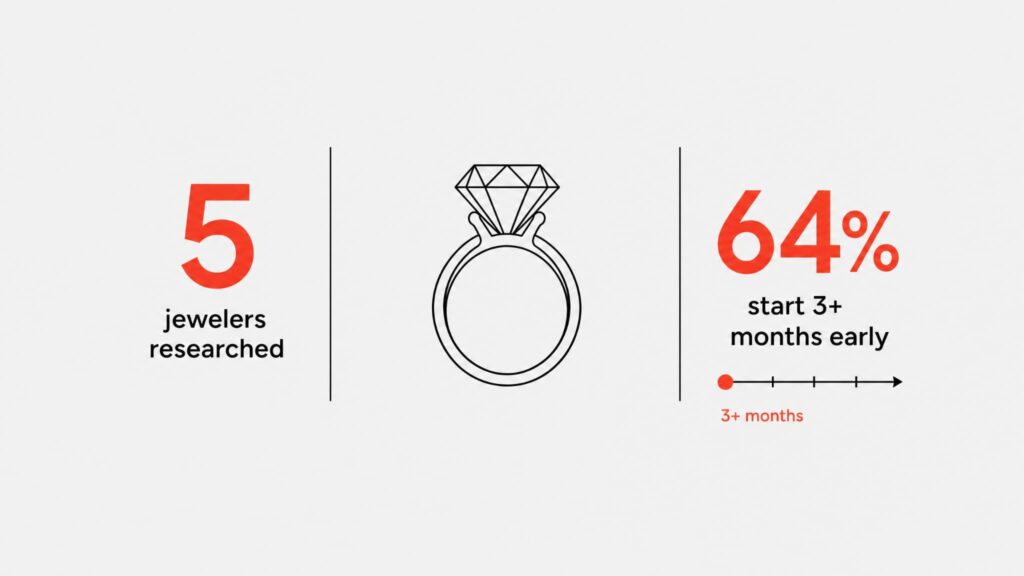
Product pages sell, but content is what earns the traffic that finds them. Buying guides, gemstone education, and care tips answer the questions shoppers research and support a high-consideration purchase. That research phase matters. The average engagement ring buyer visits five jewelers before making a purchase, and some research suggests that as many as 64% start researching at least three months in advance.
Content gives a brand a reason to stay in consideration throughout all of that, rather than being forgotten after one visit. SEO adds another layer on top. Posts timed around engagement season or holiday gifting capture demand right when it peaks. This strategy takes longer to pay off, but once it’s built, it keeps bringing in traffic with far less ongoing investment than most other channels need.
Discover Untapped Jewelry SEO Opportunities
Unlock hidden growth potential with a free, data-driven SEO audit. We analyze your website’s technical health, keyword mappings, and local presence to show you how to boost high-intent traffic.
SEO Tips for Different Types of Jewelry Businesses
Not every jewelry business needs the same SEO. An independent maker, a scaling e-commerce brand, and a local physical shop are all fighting different battles, even when they sell the same product category. What works for one can waste budget for another.
SEO for Independent Jewelers
Independent jewelers can’t outspend big retailers on ad budgets or broad keywords. So, a personal story becomes the key differentiator. Buyers searching for custom pieces are looking for exactly that story, not a mass-produced alternative. If you want jeweler SEO to work for you, lean into this rather than competing head-on with national chains.
A few things to prioritize:
Target long-tail terms.
Build backlinks from wedding blogs, craft directories, gemology sites.
Use lifestyle and scale photos.
For a small shop, this kind of SEO work is often the most popular way to compete with retailers who spend far more on marketing.
SEO for Jewelry Brands & E-Commerce Stores
Scaling brands manage hundreds of product pages at once, and each one needs its own specific keyword. Trying to rank every product for “jewelry” alone doesn’t work. Keyword research at this scale means mapping each page to a narrow term.
Write unique product descriptions.
Implement product schema so price, ratings, and availability show in search results.
Build category pages around distinct search intent.
Run paid search alongside SEO early on, since paid can fill the gap while organic rankings build.
None of this replaces the others. A brand that skips schema markup, for instance, loses rich snippets that competitors are already using to stand out in search results.
SEO for Local Jewelry Shops
A local shop’s biggest advantage is proximity, and local SEO helps turn that proximity into search visibility. But inconsistent listings can lead to issues even for an otherwise strong profile. The SEO jewelry guide for local shops applies differently than for larger brands, since foot traffic, not just online conversions, is the actual goal. Focus areas:
Keep the business name, address, and phone number identical across every directory listing.
Optimize Google Business Profile with photos and review responses.
These steps work together rather than separately. A strong profile with no consistent listings elsewhere still leaves gaps.
Final Words
SEO for a jewelry brand works best when treated as one connected system. Technical fixes, content, and local visibility reinforce each other. It takes months to build, but once established, it keeps paying off long after any single campaign ends.
FAQ
How much does jewelry SEO cost?
SEO for jewelry brands pricing varies by scope. Our tiers run $1,500/month for smaller projects, $2,500/month for mid-size work, and $3,500/month for enterprise-level campaigns with up to 20 landing pages and 90 hours of dedicated team time.
How long does it take to see results from jewelry SEO?
Timelines shift with package size. Elit-Web’s entry-level tier shows results in 9–12 months, while enterprise-level work compresses that to 4–6 months due to more resources and hours committed. You may begin to see the first metric changes within 1–3 months. But meaningful ranking and traffic growth need 3–6 months, while full ROI usually takes 1 to 1.5 years.
What makes SEO for jewelry different from other e-commerce niches?
High-value, research-heavy purchases mean trust signals matter — reviews, sourcing transparency, and detailed content that answers questions a shopper would normally ask in person. Local intent also plays a bigger role in jewelry SEO than in many other retail categories.
Ready to turn search traffic into high-value jewelry sales?
Jewelry buyers spend months researching before purchasing, yet most store websites lose these shoppers to competitors due to weak local presence and unoptimized product pages. Elit-Web helps jewelry brands scale through data-driven SEO strategies focused on high-intent keywords and trust-building content that drive measurable revenue growth.
Our approach is performance-driven: we focus on real outcomes, and our fee is directly tied to your results.
Margaret is the Head of Marketing at Elit-Web and a marketing strategist with over five years of experience in B2B and B2C digital marketing. She specializes in SEO, AI search optimization, content strategy, paid advertising, and social media growth. Her background includes developing and executing full-funnel marketing strategies for service-based and eCommerce brands in highly competitive markets. Margaret's main interests lie in performance-focused SEO, content frameworks, and scalable marketing systems that help brands grow visibility and conversions across channels.
Unlock Business Growth with Our Performance-Driven Approach
Don’t pay for marketing process. Pay for performance. Your investment is aligned with measurable performance and real business impact, not just completed tasks.
Ready to scale your brand with performance-driven marketing? Let Elit-Web turn your digital presence into a revenue engine! Get in touch with us today.
We optimize the site, create a personalized marketing experience and collect site usage data and analytics. By clicking "Accept", you agree to our use of cookies.