Margaret is the Head of Marketing at Elit-Web and a marketing strategist with 5+ years of experience in B2B and B2C digital marketing
Creating a dating app is only the first step. It is harder to attract interested users and retain them. The market is expected to reach $12.04 billion by 2035. Its CAGR will be around 7.97% from 2025 to 2035. Therefore, app store optimization becomes an important part of your business growth strategy. ASO improves app-store visibility, increases discoverability, and drives organic installs.
What Is Dating App Marketing?
Modern marketing strategies turn an interested audience into active users and paying customers. However, campaigns, creatives, and online channels alone do not guarantee sustainable growth for the brand. This raises a logical question: how to market a dating app? The fact is, attracting users to dating platforms remains costly in 2026. The average CPI is $9.84 on iOS and $3.21 on Android. Therefore, your business needs to optimize each user acquisition channel. ASO, SEO, and referrals help reduce reliance on paid advertising. Thus, a strategic approach helps improve acquisition efficiency and control marketing costs. Your goal becomes reducing CAC, increasing retention, and raising user LTV.
Understanding the Dating App Market
The dating app market continues to expand. Did you know that in 2026, 350+ million people use dating sites to find a partner? Meanwhile, 23 million people pay for premium features. Premium plans may include features such as viewing likes, undoing accidental swipes, and removing ads. At the same time, audience growth increases competition among dating brands for consumer attention. However, your app’s success depends on more than reach and user acquisition. Audience balance within your local user base also plays an important role. An unbalanced gender ratio can reduce the number of potential matches.
Different Types of Dating Apps & Niches
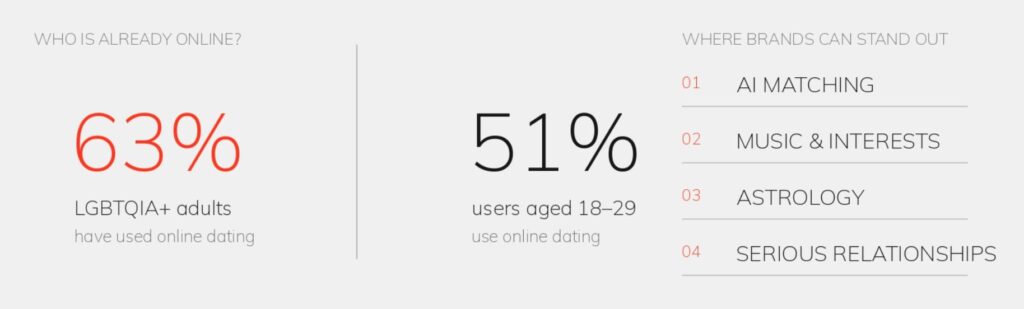
Dating apps increasingly move beyond universal and traditional dating models. In 2026, the market is actively developing around niche and AI-powered platforms. SSRS reports that 63% of LGBTQIA+ adults have already used online dating. Among users aged 18–29, the usage rate reaches 51%. Meanwhile, Tinder, a well-known global platform, is developing separate modes. These focus on music, astrology, and other user interests. At the same time, services focused on serious relationships and more precise matchmaking are emerging. Therefore, niche positioning and different types of dating will help your brand stand out more clearly.
How Users Choose a Dating App
Users choose a dating app based on criteria that go far beyond functionality. In 2026, safety is becoming the most important element of the user experience. For example, platforms such as Tinder are expanding Face Check and introducing AI tools to identify harmful behavior. At the same time, users expect more relevant recommendations instead of endlessly browsing profiles. This makes personalized experiences essential, with privacy, safety, and human interaction remaining key priorities. Users do not always view AI positively in romantic experiences. Match Group surveyed U.S. singles aged 18 to 39 in 2026. Among them, 47% viewed AI negatively in the context of romantic relationships. That means, AI should support personalization and safety without replacing human interaction.
Expert Insights
Ihor Volovoy
CEO & Co-founder at Elit-Web
Dating app user acquisition costs are high ($9.84 CPI on iOS, $3.21 on Android), making paid ads alone unsustainable. Scalable growth relies on pairing short-form video ads with optimized App Store Optimization (ASO), where simple screenshot A/B tests drive an 11.8% conversion lift. Strong ASO and SEO are essential for dating platforms to lower acquisition costs, sustain high LTV, and grow organic installs without over-relying on paid ad spend.
What Makes Dating App Marketing Unique
Marketing in this sphere is more complex than promoting other mobile products. Why? The main reason lies in the platform or app’s value, which depends on user activity. A large number of registrations is useless without enough suitable matches. Marketing must attract different audience segments while expanding reach. It is important to maintain a balanced user base across specific geographic markets. To stay on par with your competitors, you need to strengthen retention through personalization and AI recommendations. Also, your dating app marketing strategy should combine acquisition, engagement, and retention.
Building an Effective Dating App Marketing Strategy
Effective marketing in the sphere of romantic communication is not simply about increasing downloads. The main goal is to attract suitable users and turn them into an active audience. Therefore, I would recommend shifting the focus toward building a strong dating app marketing strategy. It should combine paid acquisition, ASO, SEO, social media, and referrals. It is also important to align your positioning with changing user expectations, as Bumble did. The company adapted its product mechanics in response to audience behavior. The brand allowed both participants to start conversations, not only women. It also increased the response window from 24 to 72 hours due to audience fatigue.
User Acquisition Channels
Using channels such as SEO, PPC, GEO, and SMM helps attract new users to your dating app. Search engine optimization captures organic demand and improves your app’s visibility in search results. GEO increases online presence across AI-driven search and recommendation platforms. PPC supports faster paid acquisition and helps test specific audiences. SMM expands reach and builds engagement with potential users. Influencer marketing introduces your app to relevant communities. Referrals can bring new users through recommendations from existing ones. When these channels work together, they diversify acquisition and reduce reliance on a single source. Your strategy should also track CAC, retention, engagement, and user lifetime value to identify the most effective channels.
App Store Optimization
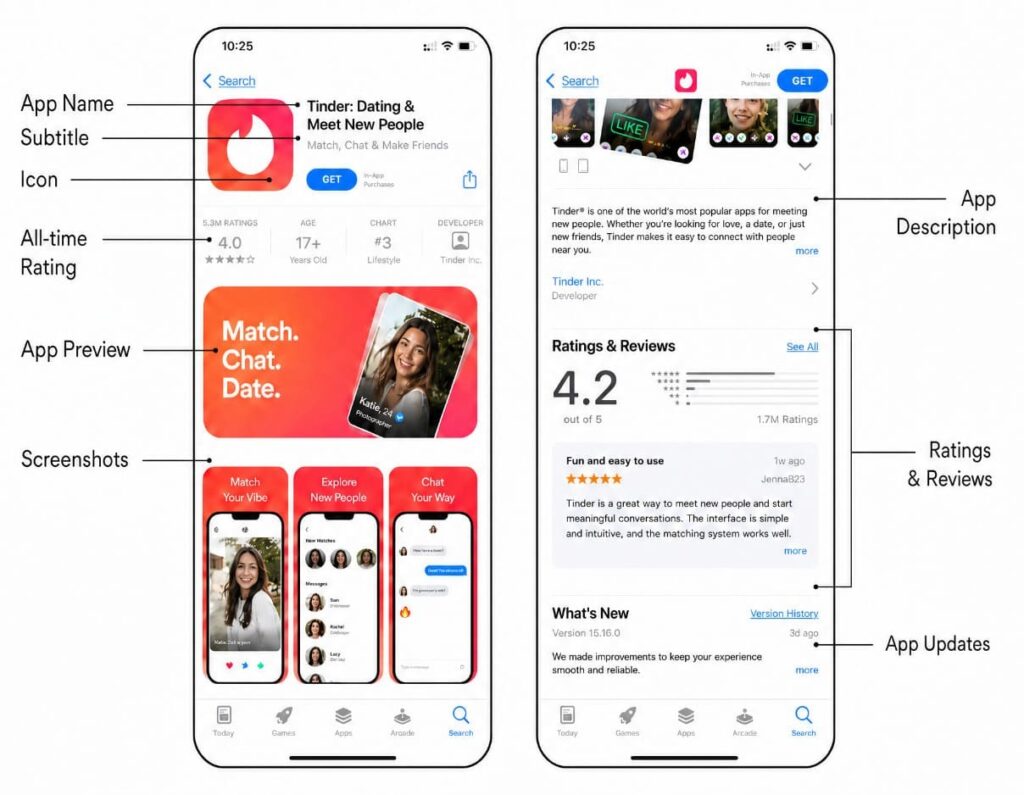
ASO helps increase your app’s visibility in the App Store and Google Play. In the competitive dating app market, strong app store visibility can directly affect the number of potential installs. Optimization includes keywords, titles, descriptions, screenshots, icons, and reviews. Keyword research helps identify search terms used by different audience segments. These insights can improve your app store listing and make it more relevant to user intent. In addition, strong visuals help your app stand out among similar offers. Therefore, effective ASO improves both discoverability and the conversion of store visitors into app installs.
Building Trust & Social Proof
Trust is important for apps focused on personal communication. Users assess safety, profile authenticity, and your brand’s reputation. Verification, real online dating stories, and reviews can reduce doubts. Social proof shows the potential audience the app’s value through other users’ experiences. You should integrate these elements into advertising, the App Store, and onboarding. Together, safety, communication, reputation, and user experience shape how users perceive your brand. Therefore, building trust should be a consistent part of your strategy across every user touchpoint.
Marketing Tactics for App Store Growth
Growth of a mobile product requires a comprehensive approach to visibility and user acquisition. The marketing tactics of our Elit-Web team combine SEO, GEO, PPC, and SMM. In 2026, search accounts for 65% of app discovery on iOS. On Google Play, this figure reaches 58%. This makes search visibility an important part of app discoverability. Optimized keywords, app store listings, and relevant content can help users find your app during the discovery process. Analytics provides data on traffic sources and helps inform budget allocation. Thus, a coordinated approach can support app visibility across the App Store and Google Play.
Optimizing Your App Store Listing
Your App Store listing should clearly present the elements that encourage users to install the app. Titles and keywords can improve relevance for searches from your target audience. Screenshots and preview videos demonstrate the product’s benefits before installation. Ratings and reviews strengthen trust and reduce doubts before downloading. Regular A/B testing helps identify the most effective combinations of page elements. This is especially important for dating apps. According to Digital Applied, screenshot A/B tests deliver a median 11.8% conversion lift.
Increasing App Sessions & Engagement
After installation, the task changes: users need a reason to return. In 2025, the average dating app session fell to 11.49 minutes, down from 13.21 minutes. At the same time, users opened apps more frequently. Sessions per user increased from 1.91 to 2.03 per day. Users may spend less time per session while returning more often. Therefore, consistent engagement becomes increasingly important. Personalized recommendations help users find suitable profiles faster. Push notifications bring users back to new matches and unfinished actions. Behavioral analytics shows where users lose interest after installation. Therefore, marketing strategies should optimize not only acquisition, but the entire engagement cycle. This approach helps turn installs into regular app usage.
Scaling Installs Sustainably
Scaling begins after identifying channels with predictable acquisition economics. The next stage is gradual user acquisition. Increase acquisition volume without compromising audience quality. As you increase your advertising budget, track CAC, LTV, and retention for each segment. Geographic expansion will help you find new markets with suitable user potential. Meanwhile, localizing creatives and offers will help adapt your strategy to different audience characteristics. This approach supports user growth while keeping acquisition costs under control.
Marketing for Different Dating App Niches
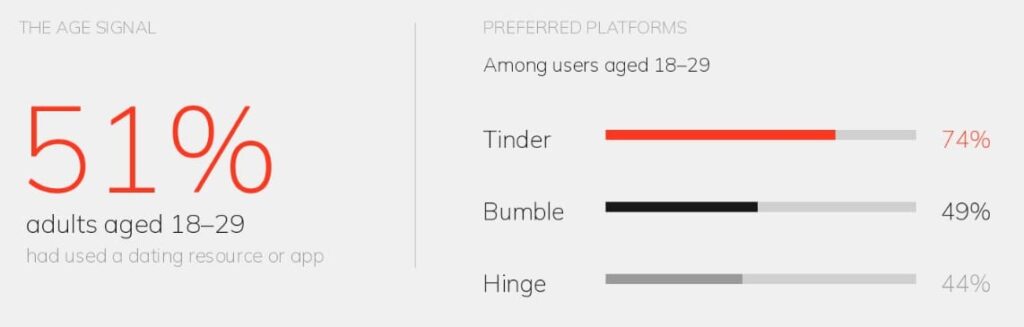
Promoting an app requires hyper-targeted communication tailored to the specific field. I want to emphasize that universal messages rarely address different customer needs and expectations. In 2026, 51% of adults aged 18–29 had used a dating resource or mobile app. The statistics are as follows — 74% used Tinder, 49% used Bumble, and 44% used Hinge.
Therefore, your marketing strategy should consider age, identity, communication goals, and geography. For your field, you need to adapt your positioning, creatives, content, and advertising channels. This approach will help you speak to users in a language they understand. Moreover, platform preferences vary significantly by age.
Apps for Serious Relationships
Apps for serious relationships focus on compatibility rather than maximizing match volume. Focus on communication that emphasizes compatibility, intentions, and long-term relationship prospects. The 2026 trend is a more mindful approach to dating, with users seeking greater clarity about intentions. This makes clear positioning and educational content especially important for serious-dating platforms. Content marketing can address topics related to compatibility, psychology, and building healthy relationships. User reviews and real dating stories are equally important, as they strengthen trust in your platform. SEO and personalized recommendations can further support discovery among users seeking meaningful relationships.
Discover Untapped Dating Strategy Opportunities
We’ll analyze your app store listings, keyword rankings, and competitor gaps to uncover why you’re missing out on organic downloads. Get a data-driven strategy to boost discoverability, increase installs, and lower your acquisition costs.
Apps in the dating market should build promotion around specific interests, values, and audience characteristics. Therefore, clearly define your community’s needs and compatibility criteria. Our Elit-Web team can help with GEO to improve visibility for niche apps. This helps strengthen their presence across AI-generated answers and recommendations. AI matchmaking can make profile discovery more personalized and relevant. It can evaluate compatibility factors that traditional profile search may overlook. Meanwhile, community and influencer marketing will help build trust within a narrow audience. Another 2026 trend is that apps should position themselves as matchmaking services.
Casual & Online Dating Platforms
Modern casual dating platforms require more dynamic communication and a faster user experience. Here, you need to focus on visual content, short videos, and social mechanics. In turn, TikTok, Instagram, creators, and paid social help quickly test different creatives. Focus on shortening the journey from installation to the first meaningful interaction. Also, use gamification and interactive features that support regular sessions and bring users back. The major platforms are reconsidering swipe mechanics due to user fatigue. Gradually shift your casual dating strategy from interaction volume toward quality.
Final Words
Understanding how to market a dating app starts with attracting the right users, not simply increasing downloads. The first stage is building a relevant audience through effective acquisition channels. The second is turning new users into active participants through strong onboarding, engagement, and retention. The third is measuring CAC, LTV, retention, and channel performance to identify sustainable growth opportunities. The marketing strategy of our Elit-Web agency can help connect these stages into one measurable process. Ultimately, dating app growth depends on balancing acquisition, engagement, retention, and audience quality.
FAQ
How much does dating app marketing cost?
Digital advertising costs range from $5,000 to over $50,000 per month in this field. At the same time, the initial launch and user acquisition campaigns require one-time investments of $100,000 to $300,000. For example, developing a dating app like Tinder costs $25,000 to $150,000+ on average. It all depends on the functionality, complexity, and amount of work involved. Apps and platforms require a critical mass of local users for normal operation. The marketing budget is equally important and should be more substantial than for typical consumer apps. For one-time services, however, prices in this industry start at $100.
What marketing channels work best for dating apps?
The most successful marketing channels for dating websites are paid social media advertising on Meta and TikTok. Short-form videos and ASO are also considered promising in 2026. Retargeting brings back visitors who have already interacted with your brand. Your brand’s success largely depends on authentic user-generated content. It increases trust and engagement among potential users. You will also need to consider precise demographic targeting and clear business positioning around dating goals. It is important to consider dating goals when setting up advertising messages. Use Telegram, YouTube, X, and other platforms for additional reach. A combination of channels helps reach audiences at different stages of the funnel.
How do you measure success for a dating app marketing strategy?
To evaluate the success of your dating program’s marketing strategy, you need to track customer acquisition costs. Then, measure activation through meaningful interactions, matches, and conversations. Retention shows whether users continue returning after their first interactions. You should also track conversion to paid subscriptions and measure customer lifetime value. Together, these metrics connect acquisition costs with user engagement and long-term revenue. Successful marketing attracts relevant users, activates them, retains them, and converts them into paying customers.
Ready to turn app installs into active, paying users and sustainable growth?
Elit-Web helps dating platforms scale through comprehensive, data-driven digital marketing strategies focused on high-intent user acquisition and long-term retention. We go beyond basic downloads: we optimize your entire acquisition ecosystem across ASO, paid media, and retention funnels to lower CAC and maximize customer lifetime value.
Our approach is strictly performance-driven: we focus on measurable outcomes, aligning our strategy directly with your revenue and active user targets.
Margaret is the Head of Marketing at Elit-Web and a marketing strategist with over five years of experience in B2B and B2C digital marketing. She specializes in SEO, AI search optimization, content strategy, paid advertising, and social media growth. Her background includes developing and executing full-funnel marketing strategies for service-based and eCommerce brands in highly competitive markets. Margaret's main interests lie in performance-focused SEO, content frameworks, and scalable marketing systems that help brands grow visibility and conversions across channels.
Unlock Business Growth with Our Performance-Driven Approach
Don’t pay for marketing process. Pay for performance. Your investment is aligned with measurable performance and real business impact, not just completed tasks.
Ready to scale your brand with performance-driven marketing? Let Elit-Web turn your digital presence into a revenue engine! Get in touch with us today.
We optimize the site, create a personalized marketing experience and collect site usage data and analytics. By clicking "Accept", you agree to our use of cookies.